

Frontend Architecture
The RTC Agent frontend is a component library built on Lit Web Components. It exposes only a single <rtc-agent> component to the outside world, containing 16 sub-components internally, managed by 9 Controllers, with data distributed to child components via @lit/context.
Component Architecture
Section titled “Component Architecture”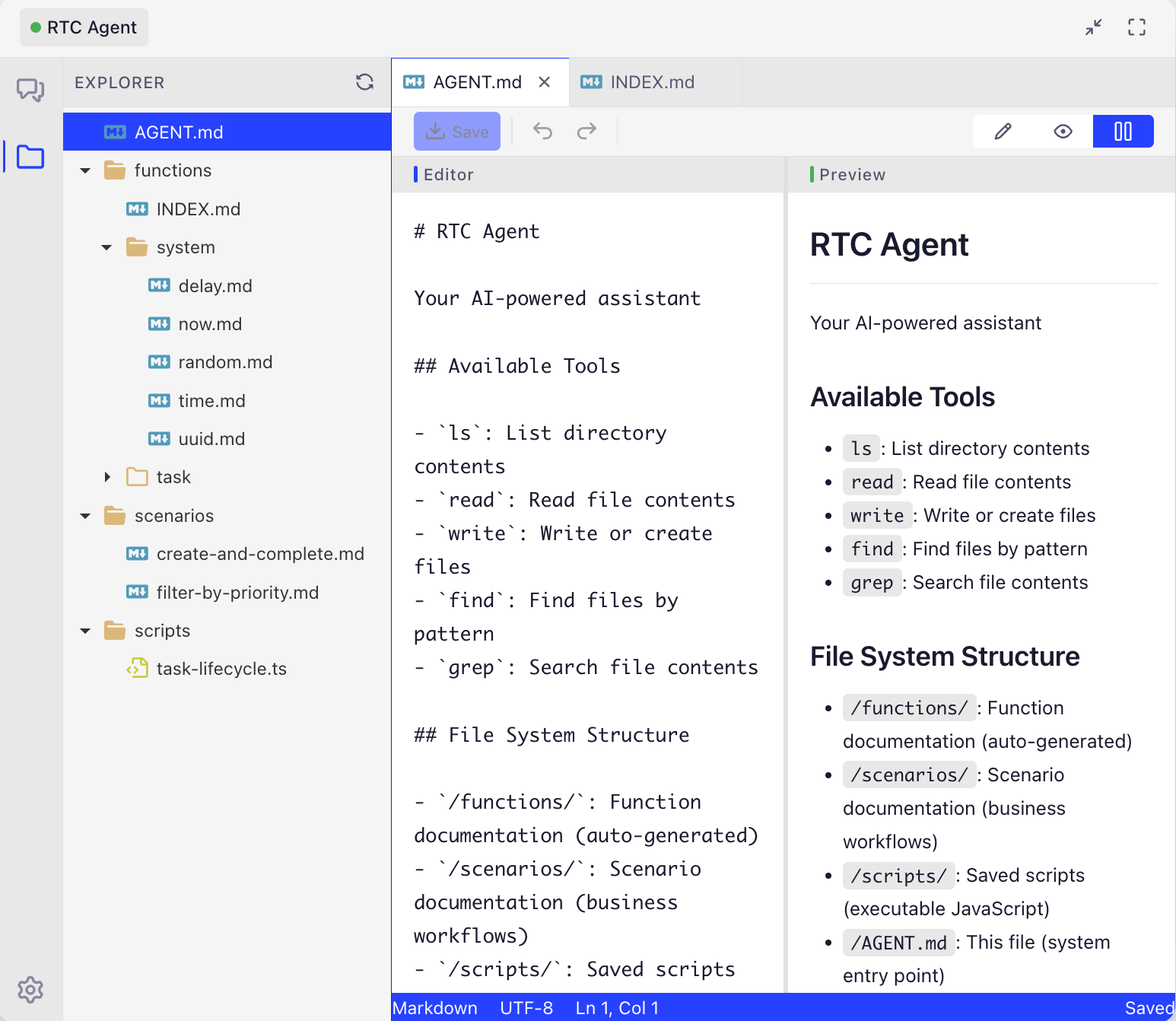
File Explorer: Left panel shows the virtual file system directory tree (functions/, scenarios/, scripts/), right panel is an editor with live preview. All file data is stored in the browser’s IndexedDB.
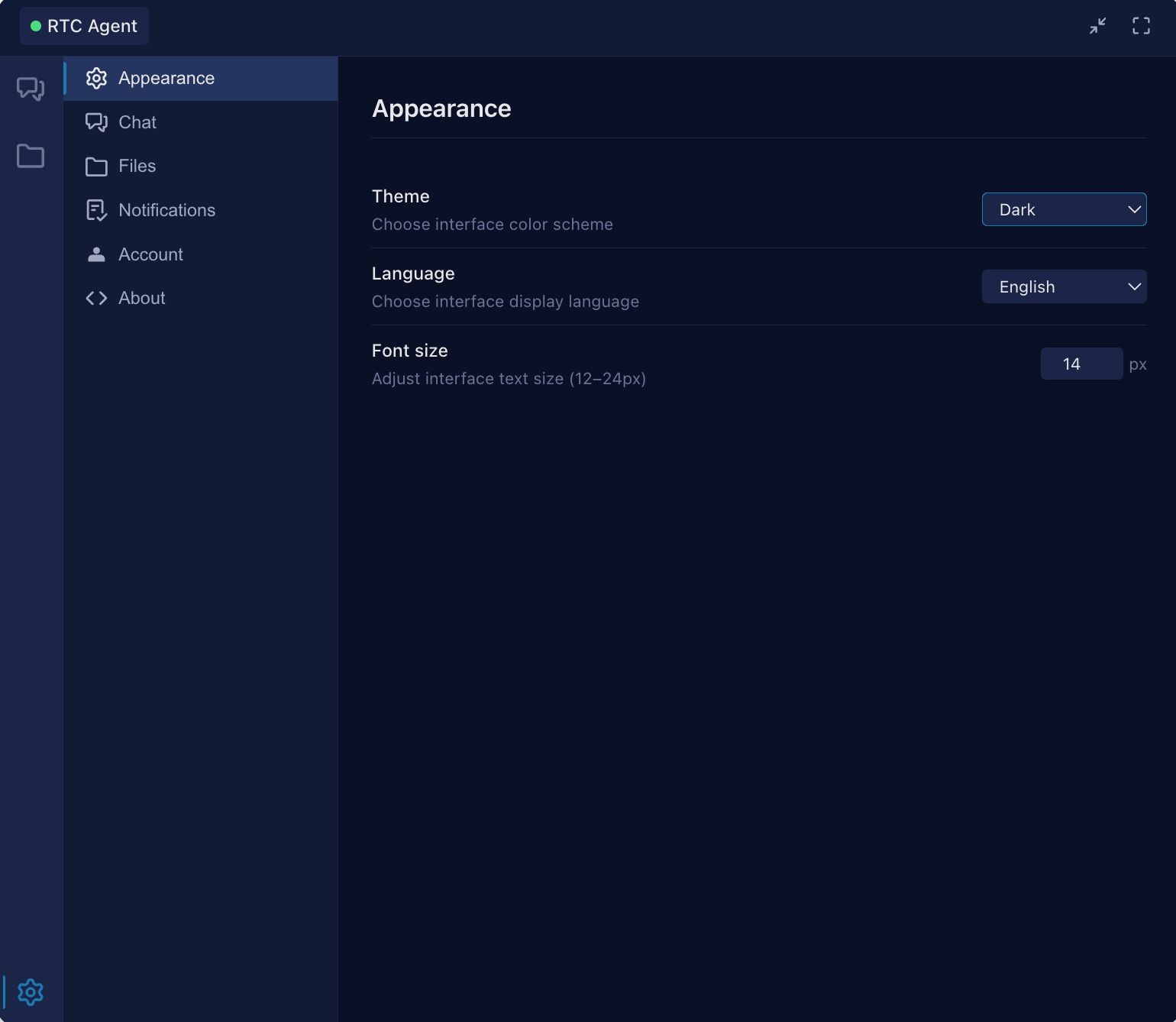
Settings UI: Supports theme switching, language selection, font size adjustment, and other personalization options.
Window management is not a standalone component:
Window Managementis a functional module of the root component (implemented by the collaboration of WindowState Controller and WindowInteraction Controller), not an independent UI component. It controls three window states: normal (floating), maximized (full-screen), minimized (bubble).
Public Component
Section titled “Public Component”Host applications only need to import a single component to access all functionality:
| Attribute | Description | Example |
|---|---|---|
theme | Theme switching | light / dark / system |
app-label | Title bar text + bubble tooltip | "RTC Assistant" |
bubble-icon | SVG/HTML inside the minimized bubble | Custom icon |
scenarios-url | Scenarios document URL | "https://..." |
agentConfig | Declarative function registration (recommended) | JSON config object |
For detailed API documentation, see Component API.
State Management
Section titled “State Management”Design Principles
Section titled “Design Principles”| Principle | Description |
|---|---|
| Controllers do not reference each other | Each Controller independently manages its own state slice |
| Root component orchestrates | <rtc-agent> acts as the hub, coordinating cross-Controller communication |
| Context distribution | State is distributed to child components via @lit/context, avoiding prop drilling |
| Data layer isolation | The Persistence Controller manages all IndexedDB reads and writes |
💡 Why not global state? Web Components run inside the host application’s page and may have multiple instances. For example, a page might embed both a “Customer Support Assistant” and a “Data Analysis Assistant” as two
<rtc-agent>elements — they need independent sessions, messages, and auth state. Controller + Context ensures each instance’s state is fully isolated with no interference.
Window System
Section titled “Window System”| Interaction | Implementation |
|---|---|
| Drag | Title bar serves as the drag handle |
| Resize | 8 resize handles — 4 corners + 4 edges |
| Keyboard | Arrow keys to move, Shift to accelerate |
| Viewport constraint | Always stays within the visible area |
Style System
Section titled “Style System”| Layer | Content | Customization Method |
|---|---|---|
| Design Tokens | Spacing, typography, border radius, shadows, transitions, z-index | Override CSS variables |
| Color Themes | light / dark color schemes | Switch via theme attribute |
| CSS Variables | Window size, bubble size | --rtc-* prefixed variables |
Key Interactions
Section titled “Key Interactions”Input Area
Section titled “Input Area”Message List
Section titled “Message List”| Feature | Behavior |
|---|---|
| Auto-scroll | Automatically scrolls to the bottom when new messages arrive |
| Smart pause | Pauses auto-scroll when the user manually scrolls up |
| New message indicator | Shows a “New messages” button when the user is not at the bottom |
| Rendering | Markdown rendering + code highlighting |
Tool Confirmation Dialog
Section titled “Tool Confirmation Dialog”Command System
Section titled “Command System”When the user types text starting with /, command input mode is triggered:
| Command | Type | Function |
|---|---|---|
/compact | RPC | Manually trigger context compression |
/loop | Local + RPC | Loop execution (scheduled / dynamic) |
/goal | Prompt | Goal-driven; AI sets completion criteria, Judge model checks |
See Commands.
Performance & Accessibility
Section titled “Performance & Accessibility”Performance Considerations
Section titled “Performance Considerations”| Scenario | Strategy |
|---|---|
| Large message lists | Paginated loading (cursor pagination); first load shows the latest 50 |
| Long conversation scrolling | Virtual scroll optimization (future release) |
| Markdown rendering | On-demand rendering; code highlighting loaded lazily |
| IndexedDB reads/writes | Unified by Persistence Controller; batch operations reduce IO |
Accessibility
Section titled “Accessibility”| Feature | Implementation |
|---|---|
| Keyboard navigation | Tab to switch focus, Enter to activate, Esc to close dialogs |
| ARIA labels | All interactive elements have aria-label |
| Screen reader | Message list uses role="log"; new messages announced automatically |
| High contrast | Supports system high-contrast mode |
Next Steps
Section titled “Next Steps”- Backend Architecture — Learn about the Go server’s layered design
- Architecture Overview — Return to the architecture panorama
- Remote Tool Calling — Learn about the core protocol for frontend tool calling
- Virtual File System — Learn about the frontend IndexedDB file system
- Commands — Learn about the complete command system